LCHS Gas Cargo Handling Simulator Course in Mumbai
Develop practical knowledge of LNG and LPG cargo operations with the LCHS Gas Cargo Handling Simulator Course in Mumbai at AIMS Maritime.
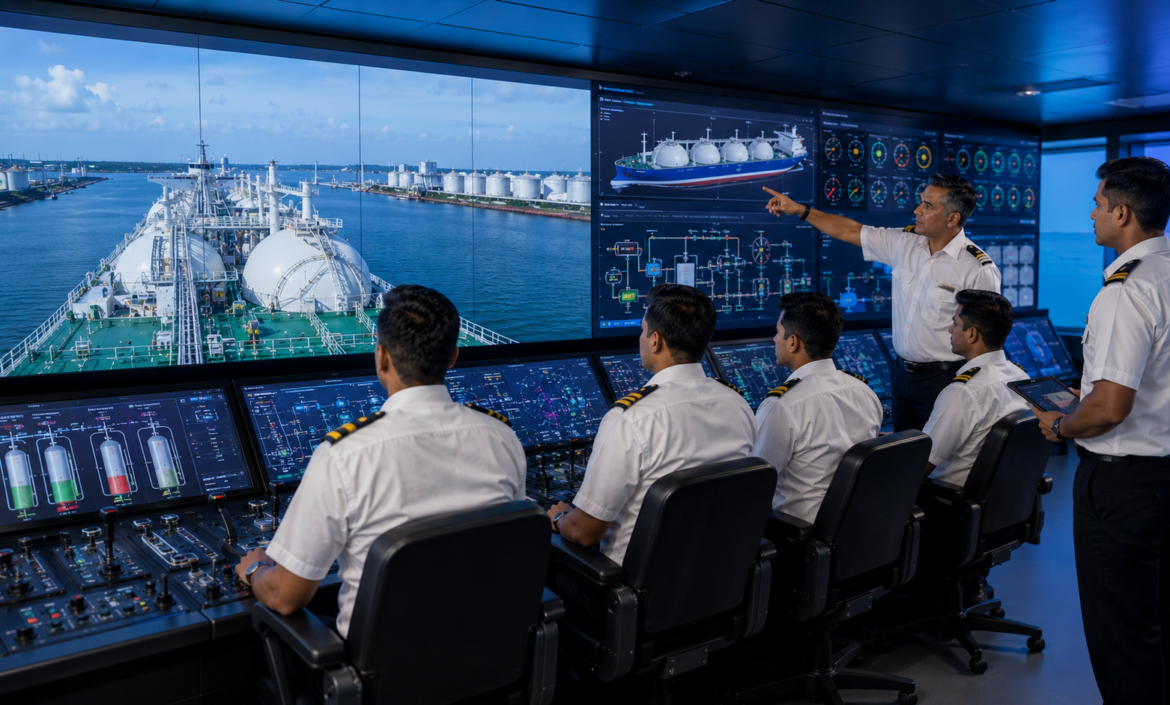
This simulator-based maritime training program helps participants understand gas tanker cargo systems, loading and discharge procedures, tank monitoring, pressure and temperature control, cargo-transfer operations, safety procedures and emergency response.
Using realistic operational scenarios in a controlled simulator environment, participants can practise decision-making, system monitoring, teamwork and response to abnormal cargo conditions without exposing an operating vessel or cargo to training-related risks.
What Is an LCHS Gas Cargo Handling Simulator Course?
The LCHS Gas Cargo Handling Simulator Course provides simulation-based training in the systems, procedures and operational decisions involved in handling liquefied gas cargo onboard LNG and LPG carriers.
Participants practise monitoring cargo-system parameters, following loading and discharge sequences, managing tanks and pipelines, responding to abnormal conditions and applying safe operating procedures.
The course is intended to strengthen technical understanding, situational awareness and operational decision-making among maritime personnel involved in gas tanker cargo operations.
Course at a Glance
- Course name: LCHS Gas Cargo Handling Simulator Course
- Training provider: AIMS Maritime
- Location: CBD Belapur, Navi Mumbai, Maharashtra
- Training method: Simulator-based learning
- Vessel focus: LNG and LPG carriers
- Suitable for: Deck officers, Masters, Chief Officers, cadets and gas tanker personnel
- Course duration: Contact AIMS Maritime for the current schedule
- Registration: Enquire about eligibility, batch availability and fees
Course Overview
Liquefied gas cargo operations require specialised knowledge because cargo conditions must be carefully monitored and controlled throughout loading, carriage and discharge.
Personnel involved in these operations must understand the relationship between cargo tanks, pumps, pipelines, valves, compressors, control systems and safety arrangements. They must also communicate effectively and respond correctly when operational parameters change or an abnormal condition develops.
The LCHS Gas Cargo Handling Simulator Course at AIMS Maritime uses realistic exercises to recreate important stages of gas tanker cargo operations.
Participants receive opportunities to practise operational procedures, monitor system behaviour, identify developing problems and make decisions in a controlled training environment.
The training focuses on LNG and LPG cargo-handling principles, operational planning, system monitoring, teamwork, safety awareness and emergency response.
Course Objectives
After completing the course, participants should be able to:
- Explain the basic principles of LNG and LPG cargo operations.
- Identify important components of a gas tanker cargo-handling system.
- Understand the sequence of cargo loading and discharge operations.
- Monitor cargo-tank pressure, temperature and level.
- Understand the functions of pumps, pipelines, valves and related cargo equipment.
- Follow cargo-transfer procedures in a simulator environment.
- Recognise abnormal cargo-system conditions.
- Apply appropriate operational and safety procedures.
- Communicate effectively during cargo operations.
- Support risk assessment and operational planning.
- Respond more confidently to simulated emergencies.
- Improve situational awareness and cargo-operation decision-making.
What You Will Learn
Introduction to Gas Tanker Operations
Participants receive an overview of liquefied gas carriers and the operational characteristics of gas cargo.
Topics include:
- Introduction to gas tankers
- Basic characteristics of LNG and LPG cargo
- Gas cargo terminology
- General cargo-system arrangements
- Responsibilities during cargo operations
- Operational communication and teamwork
- Importance of following vessel and terminal procedures
Gas Cargo Systems and Equipment
Understanding the cargo system is essential for managing operations safely and efficiently.
This section covers:
- Cargo tanks and tank arrangements
- Cargo pipelines and manifolds
- Pumps and transfer equipment
- Valves and flow-control arrangements
- Cargo monitoring and control systems
- Pressure and temperature instruments
- Level-monitoring systems
- Cargo plant awareness
- Safety and shutdown-system awareness
Cargo Loading Operations
Participants are introduced to the planning, preparation and monitoring involved during cargo loading.
Training includes:
- Pre-loading preparations
- Operational checks
- Cargo-line and system preparation
- Loading-sequence awareness
- Starting and monitoring cargo transfer
- Monitoring tank levels
- Monitoring pressure and temperature
- Communication during loading
- Responding to abnormal readings
- Completion and shutdown procedures
Cargo Discharge Operations
This section covers the principles and operational sequence involved in discharging liquefied gas cargo.
Participants learn about:
- Pre-discharge preparation
- Cargo-system readiness
- Discharge-sequence awareness
- Pump operation principles
- Monitoring transfer conditions
- Managing tank parameters
- Pipeline and valve coordination
- Communication with relevant personnel
- Completion of discharge
- Safe system shutdown
Cargo-Tank Management
Gas cargo conditions must remain within the operating parameters applicable to the vessel, cargo and approved procedures.
Training covers:
- Cargo-tank condition monitoring
- Pressure management
- Temperature monitoring
- Tank-level awareness
- Recognising parameter deviations
- Understanding system interactions
- Responding to abnormal conditions
- Maintaining accurate operational records
Cargo Transfer, Pumps and Pipelines
Participants develop an understanding of how cargo moves through the ship’s systems during transfer operations.
Topics include:
- Cargo-transfer routes
- Pipeline-system awareness
- Pumping principles
- Valve alignment awareness
- Manifold operations
- Monitoring cargo flow
- Identifying unexpected system behaviour
- Preventing operational errors
- Communication during transfer operations
Cargo Monitoring and Control Systems
Modern gas carriers use monitoring and control systems to support cargo operations and provide warnings when parameters move outside expected limits.
This section covers:
- Monitoring cargo-system parameters
- Reading system displays
- Interpreting alarms and indications
- Identifying developing problems
- Verifying operational conditions
- Prioritising responses
- Maintaining situational awareness
- Avoiding over-reliance on automated systems
Safety During Gas Cargo Operations
Liquefied gas cargo operations require strict safety discipline and adherence to approved procedures.
Participants learn about:
- Hazard awareness during cargo operations
- Personal protective equipment
- Safe working practices
- Cargo-area access control
- Communication and reporting
- Monitoring for unsafe conditions
- Following operating limits
- Risk-assessment principles
- Emergency shutdown awareness
- Importance of checklists and procedural compliance
Emergency Response and Troubleshooting
Simulator exercises help participants recognise and respond to abnormal situations before encountering similar challenges onboard.
Scenarios may address:
- Abnormal pressure conditions
- Unexpected temperature changes
- Cargo-system alarms
- Pump and equipment problems
- Pipeline or valve-related abnormalities
- Communication failures
- Interruption of cargo transfer
- Emergency shutdown situations
- Identification of immediate priorities
- Stabilisation and recovery decisions
The exact simulator scenarios may vary according to the programme, participant level and training objectives.
Operational Planning and Decision-Making
Safe cargo operations depend on preparation, communication and coordinated decision-making.
This section covers:
- Reviewing operational objectives
- Identifying potential hazards
- Planning cargo-operation sequences
- Assigning responsibilities
- Monitoring operational progress
- Recognising deviations from the plan
- Evaluating available information
- Communicating operational decisions
- Maintaining teamwork under pressure
- Conducting post-exercise reviews
Why Is Gas Cargo Simulator Training Important?
Gas tanker personnel may face complex operational conditions that cannot be repeatedly practised onboard without affecting vessel operations or safety.
Simulator-based training provides a controlled environment where participants can observe system behaviour, practise procedures and learn from operational decisions.
LCHS gas cargo simulator training can help participants:
- Connect theoretical knowledge with operational scenarios.
- Understand the interaction between cargo-system components.
- Practise loading and discharge sequences.
- Improve cargo-monitoring skills.
- Recognise abnormal operating conditions.
- Strengthen communication and teamwork.
- Practise emergency response.
- Improve decision-making under pressure.
- Build confidence before handling complex onboard operations.
Who Should Attend?
The course may be suitable for maritime professionals involved in, or preparing for, gas tanker cargo operations.
This includes:
- Masters
- Chief Officers
- Deck Officers
- Junior Deck Officers
- Gas tanker personnel
- Officers involved in LNG operations
- Officers involved in LPG operations
- Deck Cadets requiring familiarization
- Marine superintendents
- Shore-based personnel supporting gas cargo operations
- Maritime professionals seeking simulator-based cargo training
Eligibility may vary depending on the level and intended outcome of the programme. Candidates should confirm the entry requirements before registration.
Why Choose AIMS Maritime?
AIMS Maritime provides simulator-based maritime training focused on operational understanding, practical competency and safety-conscious decision-making.
The LCHS Gas Cargo Handling Simulator Course allows participants to experience realistic cargo-operation scenarios while receiving guidance from experienced maritime professionals.
Benefits of Training with AIMS Maritime
- Advanced cargo-handling simulator facilities
- Realistic LNG and LPG operational scenarios
- Training by experienced maritime instructors
- Practical loading and discharge exercises
- Cargo-system monitoring practice
- Emergency response scenarios
- Focus on communication and teamwork
- Controlled learning environment
- Industry-focused maritime training
- Convenient location in CBD Belapur, Navi Mumbai
Course Duration and Schedule
Contact AIMS Maritime for the current course duration and simulator-training schedule.
Before registering, candidates should confirm:
- Upcoming batch dates
- Course duration
- Daily training timings
- Simulator exercises included
- LNG, LPG or combined programme coverage
- Entry requirements
- Documents required
- Assessment procedure
- Certification or approval details
- Course fee and registration process
Important Training Information
This course provides simulator-based training and professional development in gas cargo operations.
It does not replace:
- Vessel-specific familiarization
- Company-specific procedures
- Applicable flag-State requirements
- Required sea service
- Mandatory tanker-training certificates
- Authorisation to perform duties onboard
Participants must always follow the approved procedures, operating limits and safety requirements applicable to their vessel, cargo and employer.
Training Location
The LCHS Gas Cargo Handling Simulator Course is conducted by AIMS Maritime in CBD Belapur, Navi Mumbai.
Training centre address:
103/104, 10th Floor, B-Wing
Agarwal Trade Center, Sector 11
CBD Belapur, Navi Mumbai – 400614
Maharashtra, India
Frequently Asked Questions
What is an LCHS Gas Cargo Handling Simulator Course?
It is a simulator-based maritime training programme covering LNG and LPG cargo systems, loading, discharge, tank monitoring, cargo transfer, operational safety and emergency response.
Who should attend the course?
The course may be suitable for Masters, Chief Officers, Deck Officers, gas tanker personnel, cadets and maritime professionals involved in LNG or LPG cargo operations.
Does the course cover both LNG and LPG operations?
The programme includes LNG and LPG cargo-handling principles. Candidates should confirm whether the selected batch covers LNG, LPG or a combined simulator programme.
What operations are practised during the training?
Participants may practise cargo loading, discharge, system monitoring, tank management, transfer operations, operational decision-making and response to abnormal situations.
Does the course use a cargo-handling simulator?
Yes. The programme uses simulator-based exercises to recreate gas tanker cargo systems and operational scenarios in a controlled training environment.
Why is simulator training useful for gas tanker personnel?
It enables participants to practise procedures, observe system responses and experience abnormal situations without interrupting operations on an actual vessel.
Does the course cover emergency situations?
Yes. The training includes awareness and simulator exercises related to cargo-system abnormalities, alarms, transfer interruptions and emergency response.
Is this course the same as mandatory tanker training?
Not necessarily. This is a cargo-handling simulator programme. Candidates should verify whether they also require separate mandatory tanker training, certification, sea service or flag-State recognition for their intended role.
How long is the course?
Contact AIMS Maritime for the current duration, daily schedule and batch availability.
Where is the course conducted?
The training is conducted at AIMS Maritime in CBD Belapur, Navi Mumbai, Maharashtra.
How can I register?
Contact AIMS Maritime to confirm eligibility, programme coverage, simulator exercises, duration, certification details, fees and upcoming batches.
Enquire About the Next LCHS Gas Simulator Batch
Strengthen your knowledge of LNG and LPG cargo systems through realistic loading, discharge, monitoring and emergency-response scenarios.
Contact AIMS Maritime for the next available batch and complete course information.
Call: +91 7710074140
Email: training@aimsmaritimeplus.com
Website: https://aimsmaritime.com/